Showing posts with label The Pragmatic Practices. Show all posts

Wednesday, September 6, 2017

The Dao of the Amateur Spycraft

(updated on 090717 at 12:12 hrs)

Securing sound and solid intelligence is the first step to establishing an efficient strategic position.  

The Boston Red Sox took that strategic pointer to a different level through technological means.  However, they got caught by their favorite rival.  Now the Red Sox is forced to admit that they have cheated.

Regardless of the outcome, one must contemplate about the lesson that is learned.  ...  Those who pursue this practice, must properly master the projected informational gathering technique before ever executing it in the field.  Being exposed for using it is usually embarrassing.  ...  

The Pragmatic Practice
This situation could have been avoided if the Red Sox had carefully utilize more than one signaler in each game and switched them during each inning for each individual games. 

Training each signalers properly in terms of initial signals and contingency signals, would have been helpful too. Therefore the Yankees would not have caught them.  

Problem: If the receiver of the signal does not possess the "emotional-intellectual" capacity to absorb the information, then he will be confused and lose track of what to do next.

The better strategic move was to expose the Yankees for the same action first.   

Conclusively, this exposure is more about gamesmanship than anything else.  In spite of this situation, both teams has to play the actual game.  

The Theory of Strategic Positioning
The "strategic positioning" concept is about gaining a position that gives the field team the advantage of anticipating a minimum of two steps ahead while moving a minimum of half a move ahead.

Depending on the timeline factor and the resources factors, the next step is determining the most efficient strategic approach.  (That is another topic)

The Compass View 
In the information economy,  most of our public actions are always being monitored and recorded.  It is important to always contemplate carefully on implementing the right strategic moves while be mindfully aware of establishing the strategic position.

When deciding on the type of strategic position, knowing the timeline and the efficiency rate of the available resources for the current situation and its prioritization to the Big Tangible Picture always help.


Minor Update
Click here on the latest update on Red Sox's Spy Gate.

Side note: A ballplayer using a mouthguard as a listening device is moderately possible because of the constant evolution of technology.  However, would that person be perceived as insane for doing so? 

Monday, August 31, 2015

The True Motive Behind Scripting The Starter Plays


One of the grandest traditions in the game of coaching football is the practice of scripting one's offensive starter plays, for the purpose of identifying the motives and the methods of their opposition. 

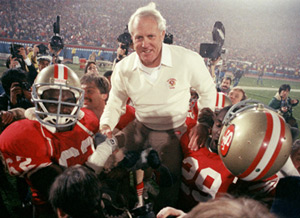
The originator of this moderately simple but innovative practice was Bill Walsh, the architect of the West Coast Offense and the former head coach of the San Francisco Forty Niners between 1979-1989.  


Beside the implementation of the script, Walsh also innovated the short-range passing attack portion of the West Coast Offense and the ratiocination for building a world class organization.


Under the leadership of Coach Walsh, the San Francisco Forty Niners won three Super Bowl Championships.  Some members of his football family have also won Super Bowls and many college bowls.


Click here on the brief history and the technicalities for scripting the starter plays


The Psychology of Scripting the Starter Plays

Before knowing the true motive behind scripting the starter plays, the smart strategist must know the following target points for scripting the starter plays: 
  • the technical weaknesses of the opposing defense (field players and sideline players);
  • the confirmation of the tactical deficiencies of the opposing defense; 
  • the identification of situational proclivity of the defensive playcaller;  
  • the approach for staging the opposing defense for adjustment plays and 
  • the staging of plays that would exploit their true inefficiencies.
By performing the above five points, the successful strategist is able to influence the opposing defense to be reactive.   


With the right play and the proper execution, this "real time" process enables the offensive coordinator to know when to call the game-changing play.  
(More to come.)

The Intricacies of Scripting Plays  

To properly develop the script of starter plays, the offensive coordinator must have the drive to knowing each and every technical deficiencies of the defense and possessed the mindset to measure and manipulate the defensive play caller and the defensive team who are operating on the field.  

When the script is working, the offensive coordinator and his scouting team begin to notice the confirmation of the targeted defensive player's base tendencies in various tactical situations (i.e., the "down and distance" situations, etc.) and their reactions to certain offensive formations, alignments, shifts and motions.


The Question of the Day
One of the unique challenges of running a scripted play while adjusting to the constant shifting of the defensive line and the constant threat of delayed blitzes and multiple blitzes from different directions. As a strategic thinker, do you know how to capitalize on that?

Side Notes
Connecting the principles from the Sunzi's essay to the process of scripting is a metaphysical challenge for the amateurs. Having the drive to seeing the Big Tangible Picture while possessing the technical foundation of strategic thinking is the key to building a good starter script.

The alpha fundamental to becoming successfully competitive is to properly assessing the strategic situation while performing one or more of the following points:

  • Building the starter script and the master script of plays on the strengths and the weaknesses of players on both sides
  • Implementing the starter script properly;
  • Knowing when to adjust to and from the starter script; and 
  • Convincing the offensive team to believe in the tangibility behind it.
The Final Note
We will publish our "Scripting" book sometime in the future.

Monday, January 12, 2015

A Note on the "Clean Off Your Desk" Day (Using a Standing Table)

Winston Churchill using a standing table

Today is Clean Off Your Desk Day.  It is always a psychological benefit to operate from a "clear, clean, neat and tidy" base of operations. 

Trivia
It has always been said that those who wanted to achieve great things, have usually operated from a standing desk.  

Leonardo Da Vinci, Mozart, Thomas Jefferson, Napoleon Bonaparte, Charles Dickens, Ernest Hemingway, Winston Churchhill were some of those great achievers, who have used standing tables for their work.   It has been rumored that Donald Rumfeld, Michael S. Dell and Christie Aschwanden are also standing tables users 

Minor Jotting
Before utilizing a standing table, achieving a state of centerness is quite helpful.  We will include the benefits of using a standing table and the various technicalities in a future post. 


The above picture is from Standupdesks.com

Wednesday, October 8, 2014

A Review on The John Batchelor Radio Show on WABC (Part 2)

updated on 10.09.2014 

Abstract 
The John Batchelor Show is the most intelligent and informative show on the radio wave.  (Some people have considered the radio to be obsolete.) I have been listening to it for many years.  The attraction is its extensiveness view on political news, and international matters.

His analysis of current events (national and international) is quite sober and intelligent.   ...  What I have always liked about Mr. Batchelor is that he doesn't overwhelm the audience with his own personal politics, unlike most right wing radio, there is substance in his show. 

The discussions on international affairs better than anyone else in the "news talk" business because of his frequently interviews with the foreign correspondents from the many international cities (i.e., London, Cairo,
Damascus, Tel Aviv, etc.) and an array of subject matter experts (sme). 

Listening to the reporting from the scene of the crime is always interesting regardless of the interviewees and the experts political leanings.   ... Differing the facts from the opinions requires some deep listening proficiency and profound strategic assessment skills.  (I presumed that you can perform that feat in a cyber moment while drinking a 20 oz of green tea.) 

Beside international affairs,  Batchelor's also touches on a diversity of national matters (i.e, economics, energy, automobiles, space programs, etc.)
... He also follows the feats of certain politicians from California, NY, Texas, and other relevant states. 


The Compass View 
There is no shouting, no screaming and no "demonization" of the other side of the political realm in this show. It is very unusual in today's political climate, which is probably why the mindless masses categorized him under the caption of boring.  ... Although I don't always agree with him, but his points are quite thought-out 

Paraphrasing what someone said previously, Batchelor's reminds me of an orchestra conductor directing his ever-talented quartet. He does a superb job in coordinating the flow and ebb of an interview during the real time of the interview. 

Interestingly I preferred his approach of refusing calls from the listeners. It filters out the "emotional debris" from the non-informative, political-leaning novices. Therefore, the information flow from the show to the listeners is smooth and concise.  

The Schema   
The show usually follows the template of focused on macro national matters and earth-shaking international affairs with great depth for the first three hours.

In the fourth hr, Batchelor usually interviews an author who has written a specific historical topic or a scientific subject matter that many intelligent people would find intriguing and educational.   


Some of these interviews are occasionally replayed on his Sunday show. You can download his show through Apple itunes and his web site

Miscellaneous Notes  
Unlike most tv and radio talk show hosts,  Batchelor's and his producer do their homework on the various topics and his array of interesting guests. He usually asks smart questions and superb follow-up questions.   ...  His daily habit of reading one book per day enhances his questioning acumen by 10 fold.   .. 

The entertainment value is in the quality of his show. His bumper music does a good job in presenting the theme that invokes the theater of the mind.  

Comments From the Compass Desk 
I believed that his show is the most "connected" radio show in terms of defining what are the significant matters and how it might impact the future of our global economy. 

This info-tainment-based radio show might not appeal to everyone. It usually requires someone who is moderately informed, reasonably well-read and open-minded.

If you wanted a sober insight from an ultra class professional,  I highly recommend the John Batchelor radio show.  

Side Notes 
Click here for part one of this topic and click here for an insightful 2011 interview on Mr. Batchelor from Jewishpress.com .


# # #

Saturday, August 16, 2014

The Best Practices of Desktop Strategists: Plan Your Work. Then Work Your Plan


Updated at 11:18 hrs

Plan your work. Then work your plan. Does that sound simple?

How can one plan their work when he or she does not know the basics for building a plan?  Better yet, does he or she know the configuration of the situation in terms of connectivity and consistency?


The Compass Process


Step One: Assess.   
Click here for the basics of assessing 

Step Two: Positioning Strategically by Planning and Preparing
Following is an abridged  listing of questions that the newbie project strategist should ask him or herself?

  • What is the first step for planning a project?
  • When does one establishes the metrics for their goals and objectives?
  • When does one establishes the priorities for their goals and objectives?
  • When does one establish the risk points for their goals and objectives?
Without the knowledge of those basics, the timeline will not be met and the project costs will escalated.  The project strategist would be lucky if half of the project requirements are met.

Some of our associates have suggested to me that the newbie strategist should take a class on strategic project management while reading the "Eight Strategy Classics" (Seven Military Classics of Ancient China + Sun Bin's Military Methods) during their off hours. It is that simple.  ... 

Step Three : Influence the Setting With One's Strategic Position
We will cover this specific topic in a future post.


Wednesday, March 19, 2014

Victory Wears a Red Shirt: The Myth Behind Tiger Woods's Red Shirt

(updated at 22:38 hr) 

Whether it is competition or everyday,  Many of us are believers or followers of certain superstitions and practices. Some carry rabbit feet, others wear baseball caps and a few of us preferred the practice of carrying a specialized script.  There are other exotic practices. 

There are some people who do believe in the power of the red shirt. 


The Red Shirt 
Since the 1990s, the great Tiger Woods has always won his final round of tournament golf while wearing a red shirt.

After his recent injury, Tiger has not won a major tournament regardless of the wearing of the red shirt.  

Speculators and rivals started the rumor that the Tiger's magic was now gone and that fear, uncertainty and doubt have begun to penetrate into the head that wears the crown.


A New Follower of The Red Shirt
A few weeks ago, Patrick Reed emulated Tiger Wood's tradition by wearing the red shirt and black pants in the final round of the WGC-Cadillac Championship golf tournament and winning it with four strokes under par.

There is nothing more humorous than a competitor who uses a psychological tactic against its originator.   It is slightly underhanded but harmless. 

Side Notes
Click here on the NY Times article on the mythology of the red shirt. You could also click here for another view. 


Psychology is Strategy
While imitation is the sincerest form of flattery, the smart strategists rarely enable the competition to use their own tactics to affect them. They always have a counter move ready for that possibility.  

Minor league rituals do not always win contests and wars.  Sound and solid preparation usually positioned the competing strategist one step closer to the starting line.  Effort and attitude usually enable him or her to break through the finishing line. 

Without depending on extreme chance, the mindful implementation of "proper execution" (in a moderately predictable setting) triumphs in most cases. 

It does not matter whether you believe in this category of tactical preparation. From our own experience, we concluded that this practice is a good psychological booster for the implementer.  

In an extreme competitive scenario, each and every advantage point must be secured from contest preparation to ritual practice to field competition. In your area of competition, do you know what it is?


Minor Jottings
"Concentrate every effort on subduing its heart and mind." 
Military Methods  33 

Implementing the counterpart's favorite tendencies could be distracting and disruptive against them. 

"In planning never a useless move.  In strategy, no step is in vain."
Chen Hao

From our own private research, extreme but successful competitors quietly mastered the technicalities behind it before ever committing to it in a real time scenario .

Conclusively, the implementation of this "unique" approach is "fair game."


#

Tuesday, January 28, 2014

A Salute to Mozart


Yesterday was Mozart birthday.  We do not know if we could say anything more about him that has been not said before.  

In our case, listening to any Mozart composition has always been a positive enjoyment.   ... 

It has been said that Mozart's Sonata for Two Pianos in D major is great for increasing one's concentration. Some called this phenomenon as The Mozart Effect.   

Click on either youtube videos.  Listen and enjoy. 


Minor Jottings
From our experience, the best way to build concentration is through the practice of still posturing in a clean, well-lighted and moderately warm room.  ... 

Those who are participate in brainstorming activities , we recommended the listening to Mozart's piano pieces and symphonies before and during the session, 


Sunday, December 22, 2013

The Winter Tradition of Reading the Classics and Other Matters

(Updated at 12:22 hrs.)

As mentioned before, being mindfully aware is the key to succeeding in any endeavor. Sometimes it does not hurt to re-read the classics to remind us of the various fundamentals of life. 

Recommended Classics
In a previous post, we discussed the topic of taking one quiet weekend to re-read the classics (The Seven Military Classics of Ancient China, Dao De Jing, Zhuang Zi, etc.) during the winter season while standing.

One of the following weekends, some of the group will be re-reading some of the following books:
  • Against the Gods (The Remarkable Story of Risk);
  • Sherlock Holmes Detective Stories;
  • The Protracted Game;
  •  The Thirty-six Stratagems Applied to Go;
  • The Tao of Physics; 
  • Strategies for the Human Realm;
  • The Tao of Deception;
  • 100 Unorthodox Strategies;
  • Dao De Jing;
  • Zhuang Zi;
  • The Romance of the Three Kingdoms; and
  • other unique strategic classics.
Here is an abridged list of the past "hot" books that we have read:
  • Anti-Fragile; 
  • Made to Stick;
  • The Physics of Wall Street;
  • The Signal and The Noise: Why So Many Predictions Fail- but Some Don't 
  • Turing's Cathedral: The Origins of the Digital Universe
For those who are audio listeners, we recommended the following books:
The rest of us will also be working on our Tangible Vision and our Compass Script while drinking hot tea.

This specific tradition and the use of the standing table have also enabled us  to hone our strategic and tactical skills.

Other Traditions and Suggestions
Following are other interesting yearly traditions that some of our strategic associates have always abide by:
  • Renewing one's yearly subscription of Business Week, Psychology Today, The Wall Street Journal and The Economist;
  • Reviewing and updating one's tactical playbook;
  • Reviewing and updating one's contacts notebook;
  • Upgrading one's own technological infrastructure; and 
  • Updating one's own security practices.
Our friends at Cook Ding Kitchen and other strategic groups have always reminded us to abide the subsequent list of suggestions that would help the underdogs:
  • Donating some cash or books to your local libraries;  
  • Donating some cash and/or food to your local charities; and 
  • Offering strategic advice to your local non-profit charities.
Comment From the Compass Desk
Practicing the process of reading the configuration of a situation, reflecting on the pluses and the minuses and adjusting to the  situation, is the daily proclivity of a good strategic implementer.

In our case, we preferred the practice of assessing, positioning and influencing.  We will discuss about that specific practice in a future post. 


# # #

Monday, November 18, 2013

The Art of the Focus: Achieving Centerness and Staying Focused

(update at 13:18:18)

Most of us are surrounded by near-bearable noise regardless of our locale. Occasionally, it interrupts our ability to think strategically.  When the volume of the noise is greater than the bio-signal that is flowing through our brains,  the progress for completing the objective becomes nil.  

Using noise-cancelling headsets  and turning off our mobile devices could only go so far. 

Pragmatic Solution #1
Finding silence and solitude is the name of the game.

Going to coffee shops is not a good idea.  Most of the time, the noise is barely tolerable. It is rare to find a place with zero noise setting.   If you are into the hustle and bustle of a noisy surrounding, go to the coffee shop or your favorite fast food chain. 

Fwiw, most successful strategic thinkers do not strategize at that setting.  It is a productivity killer.

The near-perfect sanctuary is usually that one library and finding that quiet, clean and well-lighted room while avoiding the crowdedness is always a challenge.  An associate who lives in Michigan, recommended a few  interesting "quiet" places located in the University of Michigan.


Pragmatic Solution #2
Our previous posts introduced the importance of staying centered.  Some does it through the practice of Taijiquan, Baguazhang, Xingyiquan, Yi Quan, Liu Hop Ba Fa Quan and Yoga.
To build this state of focused centerness (zhong zheng), one must do the following:
  • Relax while centering your attention to your breathing.
  • Connect to the ground by relaxing the weight of your body downward while centering your attention to the movement
  • Center your breathing to the ground while centering your relaxation and your connection to the ground
  • Calm yourself by minimal movement while centering your attention to your entire being
  • Feel the wholeness of your being while performing the four mentioned "centering" points.  
One knows when he/she has achieved the fundamental stage of this practice by being able to hear their thoughts while working. 

Side Notes
  • Our Cook Ding Kitchen associates ( principals of a martial arts blog)  usually practice a daily 60-70 minutes session of yi quan-based standing exercises.
  • Spending hours on replying to irrelevant emails and texts is also a productivity killer.  It usually disrupt the ebb and flow of the workflow.  
  • If you think that there is a power to becoming quiet, read this book.
We will elaborate more on our unique set of pragmatic practices.

Comments From The Compass Desk


To strategize properly, one must remember that silence is golden. ...  A successful strategist is usually centered and focused.  These attributes enable him to devise a well-planned and prepared strategy while being mindful that proper preparation propels profits. 

Whether you are in a library or out in the streets of New York, stay centered and focused on your objective while being mindful of your settings and beyond. 

Friday, October 18, 2013

The Compass Script Prevails Over The List

updated 10.18.13, at 13:18 hr 

Ms. Mc O'Donnell  and many people have always favored the utilization of the “list” concept in organizing their day to day operations.  From our experience and our research, it only works well in a predictable setting with minimum consequences.   Whenever they encountered an unforeseen glitch in their planning,  their simple list of objectives and approach would crumble and fall apart.  If they only did a good job in projecting ahead, this common act of inefficiency would not have happened.

Being efficient can only go so far especially if one is operating in a chaotic competitive setting.

We all know that there is usually disorder in that setting.  In most cases, the unorganized list usually winds up in the trash can.

Scripting For A Chaotic Situation 
In our case, we preferred to take the extra step of scripting our list of objectives and approaches by focusing our time on being effective not efficient.

Before proceeding into an uncertain setting, one assesses their situation before scripting the their priority objective, their approach and their contingency options.  Then he/she build their operational steps around those three points.

If one is involved in the “product development” game or in a “chaotic” logistics setting, the list concept is not always operable. With a script, one becomes cognitive on when to stay on course and when to adjust from it.     

Before the scripting of the game plan for the day or the week,  possessing the understanding of the configuration of one's own setting and the current situation, does matter.   It begins by identifying the cyclical stage of relevant strategic and tactical factors.  Then determining the coverage and the conditions of those factors.  

One should consistently assess their situation before positioning and implementing.

Overview
While our hybrid strategic approach combines the best of the "rules for strategy" mean and our tactical contingencies mean, it offers the implementer a strategic direction.  Once the configuration of the Big Tangible Picture is understood, the chief decision maker must then decide on “matching” the tactics to the situation before implementing.  

Regardless of the assessing, positioning and influencing, the results from the execution of the tactical details prevail.

For those who operate in a highly-pressured product development setting where the state of predictability is quite questionable, they should think about their approach and their operational means.

Efficiency has a way of obstructing creativity and vice-versa.  Knowing the configuration of one's setting enables one to know when to be efficient and when to be creative. 

The "Rules for Strategy" portion of our scripting process assists the implementers in strategic project situations where they must decide on whether to pursue the efficiency route or to pursue the innovation route. Our experience with our Compass Script process, gives us the feeling that this interesting modus is the key to seamless productivity.

In our settings, we have used "The Compass Script" approach for our “unique” and complex projects. The process worked quite well as long as we were mindfully aware of our settings.  

The “list” concept  is a great reminder for most novice strategic implementers. When chaos strikes, the list becomes worthless. 

In a future post, we will discuss more about the Compass Script.

Click here on the origin of the Compass Script. 

Suggestion
Click here,  here, and here  for some good strategic ideas and pointers.

( * ) !!!

Saturday, July 28, 2012

What is Your Everyday Strategic Approach?

In life, some people carry their mono-colored rabbit feet or their green tiger jade in their jacket and go with the flow.  ...  Each day, they might look at the news medium of their choice and decided on their objectives.  ... In terms of lucky objects, some of them preferred to wear one of their favorite-colored dressed shirts or carrying their lucky charm as a part of their day to day modus operandi.

The Compass Way
The Compass360 Consulting Group believed in the constant practice of assessing, positioning and influencing (API). We followed our script of objectives and approaches while being mindfully aware of our settings by scripting or re-scripting our daily plan the week before and/or the night before.  

The scripts and the plans are cautiously adjusted according to the prioritized urgencies of the situation.

Humorously, some of our other associates utilized the Taijiquan process of "Ting Jing, Dong Jing and Fa Jing" as their general strategic approach.

Q: What is your everyday strategic approach?

Sunday, November 28, 2010

Compass360 Consulting Group's Endorsement of a Software Tool


If you are looking for a very good mind mapping tool that "transforms ideas, strategic thinking, and business info. into blueprints for action", we highly recommend Mindjet Mind Manager. From our experience, it is a very easy to use software program. ... We have always use it for our brainstorming activities and found it to be a very good productivity tool.

In summary, the combination of a good strategic process and a good software tool usually creates a force multiplier for good strategic project professionals to operate from.

Side note: This is an unsolicited endorsement.  Why?  It is one of our favorite tools and we think very highly of this software tool.