Showing posts with label Jiang Tai Gong. Show all posts
Tuesday, April 18, 2017
Gone Fishing While Thinking A Few Moves Ahead
In an uncertain economy, the perceptive and experienced fisherman (strategist) always knows the risk factors for that body of water that he is preparing to fish at.
While there is near zero risk in a pond, the risk amplifies as the body of water increases. Where in the ocean, the variability of risk can change at a whim.
The weather occasionally plays a significant role in altering the movement of the ocean.
Beside the obvious preys that live in this body of water, there are predators too.
The Compass Principle of Recognizing the Terrain
The size of the terrain is usually proportional to the quantity of risk-rewards and risk-drawbacks.
The Dao of Strategic Positioning
To position ahead of the competition (or the situational curve), the perceptive strategist usually anticipate the risk factors for that situation by recognizing the risk benefits, the risk challenges and the risk drawbacks for each of the projected approaches is the initial step.
Completing the risk challenges properly and promptly, does not always mean that one would be many moves ahead of the curve. One has to comprehend the strategic configuration of the situation in terms of the matrix of connectivity and the seasonal cycle, before ever knowing how many moves ahead that he or she will be positioned at.
Whenever our latest project is completed, we will only then discuss more on this unique strategic topic.
Monday, March 6, 2017
Classical School of Tradecrafting
(updated at 16:33 hrs)
If you are not a big fan of techie solutions for transmitting messages, try the courier solution.
Food For Thought
To protect one's intellectual properties, it is important to anticipate ahead on how to convey certain parts of one's idea to their team members.
To understand the Big Tangible Picture (BTP) of one's terrain, we highly suggest the reading of Jiang Tai Gong's Six Secret Teachings.
Labels:
Jiang Tai Gong,
Six Secret Teachings,
Trade Secrets
Monday, September 19, 2016
Gone Fishing! (Another View From Chapter One of Six Secret Teachings)
Almost all asian and western strategists are familiarized with the Sunzi principles of strategy. In China, the elite strategists frequently spent their time, utilizing the concepts and the principles from Jiang Tai Gong's Six Secret Teachings and Wuzi in their various endeavors.
The Jiang Tai Gong's essay is focused on knowing the fundamentals of the Big Tangible Picture and viewing the grand events in terms of situations, events and objectives while the writing of Wuzi's emphasized on the operational means that connect the modes to one's grand tactical approach.
Some portions of the Jiang Tai Gong's material has been extended in the Li Quan's book.
We will discuss the implicit meaning behind both essays in a future post.
Sunday, September 18, 2016
Protecting Your Advantage
The Jiang Tai Gong's View
Jiang Tai Gong book "Six Secret Teachings" emphasizes "the importance of protecting one's advantage" regardless of the situation.
King Wen asked Tai Gong:"How does one preserve the state's territory?"
Tai Gong said: "Do not estrange your relatives. Do not neglect the masses. Be concillatory and solicitous towards nearby states and control all that is under you. Do not loan the authority of state to other men. If you loan the authority of state to other men, then you will lose your authority. Do not hurt those of lower position to benefit those of higher position. Do not abandon the fundamental to save those that are inconsequential.
When the sun is at midday, you should dry things. If you grasp a knife, you must cut. If you hold an axe, you must attack."
"If at the height of the day, you do not dry things in the sun, this is termed losing the opportunity.
If you grasp a knife but do not cut anything, you will lose the moment for profits. If you hold an axe and do not attack, enemies will attack instead."
"If trickling streams are not blocked, they will become great rivers. If you do not extinguish the smallest flames, there is nothing much you can do when it turns into great flames.
If you do not eliminate the two-leaf sapling, you might have to use the axe to remove it in future." "For this reason, the ruler must focus on developing wealth within his state. Without material wealth, he has nothing with which to spread beneficence or to bring his relatives together.
If he estranges his relatives it will be harmful. If he loses the common people, he will be defeated. "
"Do not loan sharp weapons to other men. If you loan sharp weapons to other men, you will be hurt by them and will not live out your allotted span of years."
King Wen said:"What do you mean by benevolence and righteousness?"
Tai Gong replied: "Respect the common people, unite your relatives. If you respect the common people, they will be in harmony. And if you unite your relatives, they will be happy. This is the way to implement the essential cords of benevolence and righteousness."
"Do not allow other men to snatch away your awesomeness. Rely on your wisdom, follow the norm. Those that submit and accord with you, treat them generously and virtuously. Those that oppose you, break with force. If you respect the people and trust, the state will be peaceful and populace submissive." - T’ai Kung Liu-t’ao (Six Secret Teachings)
More on this topic can be found in the Seven Military Classics of Ancient China.
Sunday, August 28, 2016
Influencing (Catching) the Mindless Masses in the Information Economy
Source: Saltstrong
To gain the attention of the mindless masses, the ambitious strategists need to learn how to lure them with the proper bait. It never hurts to possess a multi-facet fishing lure that performs the following features:
- Glowing in the dark;
- Flashing certain light patterns;
- Buzzing certain audios; and
- Vibrating in a periodic mode.
Q: What type of lure do you utilize to secure your targets?
Sunday, February 21, 2016
Notes on Jiang Tai Gong's Six Secret Teachings (Section 8 of Chapter 1)
Source: Orichinese
(updated at 18:18 hrs)
Source
The Civil Teaching: Preserving the State
Observed lessons
- Situations and the components that are embedded within the state it is cyclical.
- Understand the cyclical stage behind the matrix of connectivity (The Dao) of the state will enable the chief decision maker to lead and manage.
- Understanding the significance of the relevant traditions and the tangible practices for each seasonal situations.
- Disallowing the outcome of a tactical situation to be a permanent fixture in one's life.
- When the season is positive, prepare for a chaotic season.
- When the season is negative, prepare for a stable season.
- The responsibility of a principal leader is to anticipate ahead and influence people to prepare now.
Analysis
The majority of our society view most matters in the short term and presumed that tomorrow will be an extension of today. In fruitful seasons, people relax, slack off and enjoy themselves. In futile seasons, they become demoralized and consider the possibility of losing hope.
The chief decision makers should realized that all things change and the state of it are seasonal. Their role is to prepare for uncertain times when it is positively certain and influence the people to be positive and motivated when the times are negative.
Comment From the Compass Desk
The constant viewing of events and objects in seasonal cycles has always enabled the successful strategists to anticipate certain opportunities and stay ahead of the curve.
Click on this link on more information on Jiang Tai Gong and Six Secret Teachings.
Comment From the Compass Desk
The constant viewing of events and objects in seasonal cycles has always enabled the successful strategists to anticipate certain opportunities and stay ahead of the curve.
Click on this link on more information on Jiang Tai Gong and Six Secret Teachings.
Thursday, January 7, 2016
Notes on Jiang Tai Gong's Six Secret Teachings (Section 7 of Chapter 1)
The observed lessons from the seventh section of chapter one (The Civil Teaching: Preserving the State Territory) are:
Analysis
A critical concern for a CEO is to sustain their territories, protecting against both attack from without and division within.
To avoid any incursion, be mindful to the politics in other organizations, especially those with who you share some level of commonality. Notice the personalities of their leaders especially those with aggressive and acquisitive nature. It is suggestive to build alliances with certain ones, yet never fully trust them.
One aspect of strategic power is about creating a perception that other people would believe that you have more than the actual resources at your command. Managing their perceptions is quite important. If you fail to act when others expect you to do so, then they will assume you have less power and, in doing so, reduce your power. Appropriate action is hence important, and none more so than when there is a threat of incursion.
When a person has gained the power of CEO, there is a strong possibility that their relatives may become envious and try to usurp him/her, killing them and taking their position. History is full of examples of this category of events. Managed these relatives carefully and they can be your greatest supporters. (cross-reference to Jiang Tai Gong's Six Preservations chapter.)
It is also important to address the concerns of the common people, whenever there is chaos that could affect their lives.
Those who wanted your power will often pretend first to be your friend and may even weaken you by borrowing or utilizing your resources. Be aware of that action.
|
Monday, October 19, 2015
Notes on Jiang Tai Gong's Six Secret Teachings (Section 6 of Chapter 1)
(updated at 10.20.15 2:22 hrs)
The observed lessons from the sixth section of chapter one (The Civil Teaching: Six Preservations) are:
- To keep their position, a CEO should use six preservations: benevolence, righteousness, loyalty, trust, courage and planning.
- To find people who will use these, give them power and responsibility, then watch how they behave. Endanger them and watch.
- Never lose the three treasures: products/services that fulfill the immediate gratification of the masses; the building of productive tools; and customer service (The original transcript states agriculture, industry and commerce as the three treasures).
- People who operate in similar profession should live in the same location.
Of the six preservations:
- Benevolence shows care of others, who will care in return.
- Righteousness shows fairness and so avoids indignation.
- Loyalty engenders love and reciprocal loyalty.
- Trust gives people the scope to betray, exposing those who cannot be trusted.
- Courage leads people to admire you and inspires them to bravery too.
- Planning leads to deliberate and reliable action that benefits from thought rather than hope
Position people into "stressful" situations, where they can utilize their influence to save themselves by harming others, is a great test of character. We all have "stress" values, which are different to our everyday values.
Of the three treasures:
- Providing products/services by technologists and specialists that offered immediate gratifications to the masses (Original transcript- Agriculture is performed by farmers who feed the people.)
- Industry is the characteristic of engineers and inventors who build productive objects.
- Commerce is utilized by marketing specialists who provide the services and goods for the consumers and sell the excess products of many.
The three treasures are the basis for an ambitious capitalist-driven company today, as well as in ancient China. If all three treasures are secured, then the overall financial state of a company will thrive.
Friday, August 28, 2015
Notes on Jiang Tai Gong's Six Secret Teachings (Section 4 of Chapter 1)
(updated 13:11 hrs)
The observed lessons from the second section of chapter one (The Civil Teaching: Fullness and Emptiness) are:
- The chief executive officer (CEO/ ruler) should stay close to the other c-level officers and the senior managers (ministers).
- They (other C-level officers and senior managers) should not conceal significant organizational and business matters from the CEO and should comply with the wishes of the CEO.
- The CEO should be composed, dignified, restrained.
- The CEO should see and hear with clarity, integrating different perceptions and understanding deep matters.
The Chinese classics compared the ruler to heaven and the ministers to earth.
In a modern setting, the chief executive officer should always take a top-level view but does not get involved with the day-to-day running of the organization -- this is the role of the senior managers. While it is tempting for some chief executive officers to involved themselves with the detail, the consequences for lower oneself to the position of senior managers is to lose their respect.
The question then is how does a CEO lead (or how does a ruler rule), if they say little? The answer must be that what they say should be of great importance. They pull the larger levers of power. The senior managers and those below them turn the wheels of the organization in an aligned and synchronized response. In this way, the wishes of the CEO are achieved with grace and ease.
The principal skill of all successful CEOs is listening.
Each person who speaks to the CEO does so with an agenda, a purpose in what they say. The CEO should focus on this purpose and identify the truth amidst the bias. The most efficient mean to securing the truth is to listen to the different perspectives and determine the underlying common issues behind it.
Tuesday, August 25, 2015
Notes on Jiang Tai Gong's Six Secret Teachings (Section 5 of Chapter 1)
The observed lessons from the fifth section of chapter one (The Civil Teaching: Cleared Instructions) are:
Comments From The Compass Desk
The section starts with the Emperor Zhou asking Jiang Tai Gong, the sage-strategist for clear instructions on what can he teach his son and the future generations.
The sage-strategist responded by that The Dao is the absolute principle that underlining the matrix of connectivity and order within the universe. It is the base concept of Daoism. The masses use it as the practical guidance in how to live in harmony with the world.
The 'Dao' literally means 'the path' or 'the way'. It can also mean 'discipline'. The professional view the Dao as the Singularity. (Hint: Read Chapter 1 and Chapter 42).
Most translations of Laozi's book Tao Te Ching, offered the perspective of the Tao that is similar to Buddhism in reference to the preaching of peaceful intent, modesty, minimalism and open-mindedness.
The book also encompasses the duality of yin and yang, where each quality is embedded deeply within the other. Conclusively, there is hardness that is embedded in the soft factor and that there is softness embedded in the hard factor.
This perspective is also found in the practice of Taijiquan and other Chinese internal martial art systems. The way (or the path) of a great leader is parallel to that of a warrior, where he senses the way and the flowing with the forces around his terrain. Most people cannot define the Dao, yet they constantly strive towards it. |
Wednesday, August 12, 2015
Notes on Jiang Tai Gong's Six Secret Teachings (Section 2 of Chapter 1)
- Some countries (or organizations) are chaotic while others are in order;
- The state and fortunes of any country (or organizations) are due to the leadership qualities of the emperor (chief executive officers), not by chance, divine beings, etc.
- A worthy ruler focuses on the interest of others while not living in a grand comfort nor does he adorns himself with an exquisite setting.
- Greatness originates from one's own integrity and how he/she treats his followers, the outsiders and the observers.
- Rewarding those who are loyal and who respect others.
- Rewarding good acts from people who have done bad things.
- Identifying and prohibiting unethical practices.
Comments From The Compass Desk
"Full and Empty" is a principle that is connected to the macro concept of Yin and Yang. This concept is also used in Daoism and Chinese martial arts.
Regardless of the activity, we breathe by alternating the motion of full (yang) and empty (yin).
Fullness can also mean being connected to the entire organization (or country), feeling everything within oneself.
Emptiness can be described a divesting yourself from activities that are not match your standards of ethics and quality. It also alienate you from the people within the organization.
Fullness implies action. Emptiness involves patience. There is a place for each quality. Having a mindful state of the connectivity that exists within the Big Tangible Picture (BTP) is the focus point of the successful strategists.
Applying to Competitive Strategy
If someone attacked us, we yield displayed emptiness (yin), giving them nothing to press against. As they returned to their position (for the purpose of regaining balance), we follow, stick to the essence of their position with the force of fullness (yang)
Side note
This strategic classic was written by Jiang Tai Gong, the father of Chinese strategy.
(Opps! The order of the chapters are incorrectly posted. Ugh!?. Click here for section three of chapter one)
Monday, August 3, 2015
Notes on Jiang Tai Gong's Six Secret Teachings (Section 3 of Chapter One )
(updated on 08.03.15)
The observed lessons from the third section of chapter one (The Civil Teaching: Affairs of State) are:
Comments From the Compass Desk
|
Side note
This strategic classic was written by Jiang Tai Gong, the father of Chinese strategy .
Wednesday, June 3, 2015
Comparing the Basics of Jiang Tai Gong's Six Secret Teachings to Sunzi's The Art of War
In the business world, there are some MBA executives who loved to recite the quotes from the Art of War for the purpose of motivating the troops. Some of these motivators are just bi-polar salesmen who are seeking new ways of motivating themselves by "pumping up" their troops.
Most of these chosen ones do not know how to use the Art of War principles in a sequential mode. It tells us that these wanna-be's are not strategists in the purest sense.
(updated 06/03/15 15:15 hrs)
The serious strategy professionals usually preferred to read Jiang Tai Gong's book that teaches the readers how to view the Big Tangible Picture from the perspective of a chief level officer.
The book starts by delineating the grand perspective of an organization by profiling the circumstances behind the chief-level officer (chapter one and two) to their choice of field leadership (chapter three). The last three chapters (chapter four, five and six) accentuate the fundamentals of understanding the tactical preparation and implementation for subjugating the competition .
By gathering the correct quantity of quality intelligence, one can conclude the strategic state of that organization.
Conceptual Difference #1
While the gist of Sunzi essay is focused on understanding the current strategic situation from ground up, the Jiang Tai Gong's classic is focused to understanding the grand strategic situation from the "top down" perspective.
Conceptual Difference #2
Chapter one and two of this strategic classic are focused on the fundamentals of advising a client
Conceptual Difference #3
Each chapter teaches the consultant on how to influence the client with am improved perspective.
Comments From The Compass Desk
From ancient China until now, this classic has been used to enlighten those who are seriously involved in the profession of strategic consulting and competitive intelligence gathering.
We will discuss more on the differences between the fundamentals of Jiang Tai Gong's Six Secret Teachings to Sunzi's Art of War in a future post.
Tuesday, March 31, 2015
Succeeding in the Info Economy by Understanding the Big Tangible Picture
(Updated on 04.11.15)
One of our associates has a small tendency of losing track of the Big Tangible Picture (BTP) whenever the stress becomes overwhelming. In some occasions, So he takes a few days off and visits his favorite fishing hole.
That fishing hole is a solitary locale that allows him to hear his thoughts and his own rants . There are usually no digital devices or any people near him.
This setting of tranquility enables him to think through his many situations and an assortment of questions.
Following is an abridged list of those questions:
- What tangible bodies of water should he be fishing at?
- What are the risk benefits, the risk challenges and the risk drawbacks for fishing at that specific body of water?
- What types of fishes could/should he catch?
- What are the risk benefits, the risk challenges and the risk drawbacks for catching that fish?
- To lure a big fish, what type of bait does one needs?
- Is his fishing line strong enough to hold the fish?
- Does he need a team?
- If so, what is the common interest in attracting the right team?
- How does he attract the right team?
At the end of the day, this associate re-reads Jiang Tai Gong's Six Secret Teachings.
During the reading process, he makes the effort to compare the essence of that classic to Sunzi's Art of War. (I presumed that some of you have already done that and will be publishing a book on that topic soon.)
The Compass Principle
The quantity of relevant answers is proportional to the tangibility of The Big Tangible Picture (BTP).
The quality of the answers is always proportional to the probability of the fisherman's success.
The type of fishes that one pursues, is usually based on their feel for risk.
Side Note
Fwiw, there are more questions to this list. We will elaborate on the other questions in a future post. Some of these questions, could be found on somewhere in this blog. Good luck in finding them!
Comments From The Compass Desk
Going to a quiet watering hole is the first phase of the process. Once the relevant answers are known, the next step is assessing it in terms of strategic efficiency.
Positioning ahead by developing the script. That is the next phase.
During the reading process, he makes the effort to compare the essence of that classic to Sunzi's Art of War. (I presumed that some of you have already done that and will be publishing a book on that topic soon.)
The Compass Principle
The quantity of relevant answers is proportional to the tangibility of The Big Tangible Picture (BTP).
The quality of the answers is always proportional to the probability of the fisherman's success.
The type of fishes that one pursues, is usually based on their feel for risk.
Side Note
Fwiw, there are more questions to this list. We will elaborate on the other questions in a future post. Some of these questions, could be found on somewhere in this blog. Good luck in finding them!
Comments From The Compass Desk
Going to a quiet watering hole is the first phase of the process. Once the relevant answers are known, the next step is assessing it in terms of strategic efficiency.
Positioning ahead by developing the script. That is the next phase.

Enjoy your day!
Thursday, October 23, 2014
Fishing in San Francisco (A Modern Day Version of Jiang Tai Gong)
source: sfgate . com
Mr. George Revel of Lost Coast Outfitters is a smart businessman who loves fishing. He assessed his terrain in terms of the social-economic factors by understanding the social economic demographics.
Conclusively, he decided to pursue the big fish.
"He is casting for the big fish. ... In the urban environment, you see fly fishermen who are doctors, lawyers or in finance,” he said.
Those are his key demographic. They drop by the shop, handle the cool gear and maybe even head up to the roof to try some casts out toward the San Francisco skyline.
And often, once they do all that, Revel has them where he wants them.
They’re hooked. ..."
Click here to read the rest of this interesting article (from SFGate.com) on a modern day Jiang Tai Gong .
A Few Notes on Jiang Tai Gong
The Six Secret Teachings is a favorite book for the serious strategists who wanted to understand the Big Tangible Picture (BTP) of an extreme competitive terrain for over two thousand years. Those who are involved in the modern consulting/ strategy game, could learn something from this classical book.
The Origin
In the Zhou dynasty of the 11th century BC, an elderly, eccentric advisor known as Jiang Tai Gong wrote a book that outlined a set of principles relating to government and warfare through the reported conversations with Emperor Wen and his successor, Emperor Wu.
Throughout Chinese history, there were many "secret teachings" and "confidential notebooks and essays" in many areas. Labeling these certain items under the category as a secret makes them more desirable as they seem scarce and harder to access. To access these so-called secrets typically requires investment that leads to greater commitment, as the student acts to sustain consistency with their investment.
(There is a long range benefit from learning from this "exclusive" manual. We could tell you. But it is better if you read it.)
Chapter One: King Wen's Teacher
The first chapter introduces King Wen and his meeting with his teacher, Jiang Tai Gong who utilizes the analogy of fishing to offer learning points.
He talked about the importance of being a 'True Men of Worth' and that it is the type of person that any wise ruler should be. By speaking in this manner , the Tai Gong immediately suggested that he could be his close adviser. The king immediately understood the value of Jiang Tai Gong's words (and being advised by his scribe), accepted this relationship.
The Art of Bait and Lure
Chapter One briefly talks about catching "the big fish." Regardless of the requirement of the big bait and a strong line to catch big fish. It is significant to be committed to this process.
If you are cautious or offer only simple bait, the big fish will detect your lack of commitment and either ignore you or capitalize on your weakness.
This section includes a direct reminder to the ruler to be kind to his people, pointing out how followership is thus created. The lesson that many of today's leaders still need to learn is that there is a base human nature towards the utilization of punishment and reward others when motivation is needed . It requires more skill to utilize kindness that leads people to truly want to do as you ask. This enables you to seldomly command the people to do your bidding.
Lessons
- A true man of worth is usually ambitious. (Using the fisherman analogy) the fishermen of worth pursued the whales and the sharks while the common fisherman have ordinary and common goals and he catches only guppies and minnows.
- True men are drawn together by common interest in significant affairs.
- To lure a big fish, one needs a big but attractive bait and a strong fishing line. This may require significant commitment from the ambitious leader. Simple, glittering rewards only attract the small fry.
- A worthy (or sage) ruler utilizes many approaches that play to the emotions of his counter parts. He shows humanity, virtue and righteousness by sharing, sparing, relieving and eliminating hardship. This is the manner to create followers.
Side Notes
Other future posts on Jiang Tai Gong will include brief notes on the gist of each relevant chapter of this classic.
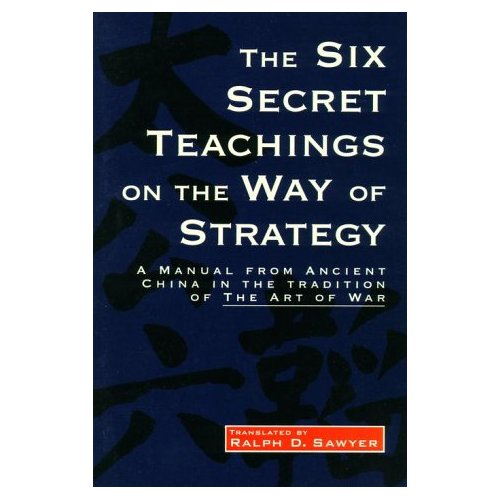
For more detail on this chapter and the full translation of Six Secret Teachings, read Dr. Ralph D. Sawyer's Six Secret Teachings or Seven Military Classics of Ancient China (1993).
In the age of instant information and immediate gratification, some people do not know what is tangible anymore. The truth that originated from the classics, has never changed. One just have to be mindful of the importance of the components within their terrain and beyond.
Saturday, August 9, 2014
Scripting to a Victory (The Bill Walsh Way)
(updated at 15:15 hrs)
One of the most interesting traditions/practices in sports is the scripting of the game plan. From the 70's to the early 90's, Coach Bill Walsh innovated and utilized the concept of scripting the first 25 plays in his games. Then employing the results as a springboard to dominate his competition.
This process model has assisted him to win three Super Bowls and two college bowl games.
His many prodigies have also employed it to win their shares of high stakes games and championships too.
The Basics of Scripting
Scripting is one of those unique practices that is worth learning and using. This practice enables the implementers to maximize their level of strategic efficiency. It is quite easy to learn, but moderately difficult to implement for the obvious competitive reasons.
Retrospectively, the completion of a script usually provides the principal script developer/chief decision makers the feeling of self-preparation. It also gave them a level of confidence.
The basic essentials are: a clipboard, some lined paper, some good writing pens (with red ink, blue ink, black ink and green ink), patience, persistence. a well-temperature room with an extreme state of quietude, a coffee pot of warm water, some tea leaves and the skill of assessing, positioning and influencing.
Having an assortment of white boards, a tablet PC and/or a smart phone is not always essential for script development. But it never hurts to have them.
The Compass Project
We are currently working on a book project that focuses on the fundamentals of scripting through our macro process model of Assessing, Positioning and Influencing.
This book is focused on the fundamentals of shaping and staging the competition through the application of an array of Chinese strategic principles and stratagems by scripting the right meta-tactical plays.
How to Script One's Gameplan
One needs to know the objective, the approach, their means and the modes of each competitor before deciding on the different types of scripted plays and the order of the scripted plays.
This approach enables the offensive play caller to decide on the approach for staging the competitor for a knockdown or a knockout while utilizing their opponent's proclivity as one of the key indicators. There are other key indicators that will be discussed in our current book project .
The Problem of Losing One's View of the Big Tangible Picture (BTP)
In the heat of the battle, some people usually forget the specifics behind their objectives and begin to panic while mis-comprehending the circumstances for staying on course or exiting from the gameplan.
Our solution is the usage of the Compass PACE guidelines. It guides the offensive play callers to know when to stay on course or when to change direction in certain situations.
Building the PACE Guidelines
The development of the PACE guidelines before the scripting of the array of tactical plays, allows the chief strategic decision makers to understand what is their target and what direction they are pursuing.
What are the PACE Guidelines
- Priority Objectives: This category focuses on the ranking and the specifics of the targets
- Approach: This category focuses on the definition of the strategic timing points for being efficient and flexible
- Condition: This category focuses on the possibility of certain positive case scenarios and the contingency plans
- Exception: This category focuses on the possibility of certain negative case scenarios and the contingency plans
We will delineates the psychological reasoning for using the PACE guidelines in a future post.
Identifying the math and physics behind anything relevant is sometimes easy.
Establishing the Adjustment of the Big Tangible Picture
Once the scripted play is called, the offensive play caller knows something about the defense while the defensive play caller might know something about the state of the offensive team. Based on the previously called play and other factors, the defensive play caller could possibility figure out the offensive play caller's next possible play.
“Oh, what a tangled web we weave...when first we practice to deceive.”
- Walter Scott, Marmion
Once the allotment of the scripted plays are called, the game of cat and mouse begins. The offensive play caller might decide to recirculate some of the previous scripted plays or run a variational change off those plays.
A Mini-Test Case of a Scripted Play
From a Opening (Starter) Plays Script
Situation: 1st down and 10 or 2nd down and short, on one's own 30 yard line.After implementing a quick trap to strong side from the pro set formation (slot left, TE Right) on the second play (regardless of the result in some instances), the offensive play caller might signal the same play with either one of the following options in the 26th play:
- same run play with a different set of shift and motion by the wide receivers
- a play action pass with a five step drop; and
- a play action pass with a QB rolling out to the weakside.
Side note: Most playcallers preferred the 15-20 plays script model for the psychological reason that they feel that they would have a good read on the competition's intent and methods. A few might run a 25 plays script for the obvious reason of exposing the probable deception lead by the defense.
Those who are deeply skilled in the art and science of strategic shaping and staging, preferred the 25 plays option.
Comments From the Compass Desk
Regardless of the array of innovative concepts that Coach Walsh has contributed to the game of football, the script is one of the most useful tools that could be applied to modern day life.
In an unpredictable setting, the tool enables the implementer to strategize in terms of contingencies.
Click here on some of the basics of scripting
As mentioned before, the smart strategist could build a script with the following items: a quiet and well-temperatured room; a ream of lined paper; colored pens and a good set of assessment skills. (In some instances, high tech tools are not needed.)
There is a psychological reason for using pen and paper for the initial stage. Those who have seriously studied Yi Quan or Taijiquan, would understand why.
# You do know how to assess. Do you?
Whenever you watch a football game, ask yourself if the offensive coordinator is calling a well-scripted game.
Side Note
We didn't published our book on assessing strategically through the employment of Sunzi's strategic principles because of the quantity of Sunzi's type of books that were being pushed in the published books marketplace. Most of these books were quite average or below average regarding to their concept of applications and new ideas.
Some of them repeated the same obvious points- "if they do this, you do this" type of approach without ever emphasizing on the importance of comprehending the strategic state of the situation. They also outlined the same old idealistic rules of thumb.
For the apparent reasons, the approach of utilizing the rules of thumbs and the simplification of perspective is for amateurs.
These writers have not thoroughly learned the process of "assessing strategically", one of the holy grails behind the Sunzi's essay. Some aspects of this skill can be found in Jiang Tai Gong's Six Secret Teachings.
Our intent was not to get lost in the abyss of high noise and low signal.
.
What makes our book unique is our focus on the connectivity between the scripted plays to the categories of adjustment plays and situational plays.
Whenever the book is published, we hope that you like it.
A Few More Side Notes
Click here for a field level example of assessing, positioning and influencing.
For the Niners Faithful, we recommended this great book by Daniel Brown- 100 Things 49ers fans should know and do before they die and Bill Walsh, Steve Jamison and Craig Walsh's book - The Score Takes Care of Itself.
Our associates at Cook Ding's Kitchen have always reminded the novices and the neophytes that one cannot successfully strategize if he or she is not able to stay focused on their immediate objective. They also reminded them that the reading of the Art of War does not help either.
# # #
Subscribe to:
Posts (Atom)


.jpg)